
Seattle freezes are short, but wet concrete takes the hit. Keep water out, protect sound slabs, and repair or overlay only where damage has started. Photos + free on-site assessment.
Proudly serving Snohomish & King County, WA
Freeze-thaw damage happens when water soaked into concrete freezes, expands, and pushes the surface apart. In Seattle and the rest of Western Washington, hard freezes are usually brief, but driveways, patios, walks, and steps stay wet for months. That means even a handful of cold nights can flake paste off a slab that never dried out. The best protection is keeping water out: move it off and away from the concrete, keep a breathable penetrating sealer on sound surfaces, and go easy on ice melt. Once the surface is already scaling or spalling, sealer will not bring it back. At that point the choice is a patch, a bonded overlay, or a section replacement, depending on how deep the damage goes and whether the slab underneath is still solid. Olsen Concrete (Lake Stevens) handles the repair side for homeowners across Snohomish and King County. Call (425) 215-2560.
Think of freeze-thaw protection as three stages. Find the one that matches your slab:
Olsen confirms which stage you are in with a complimentary phone/photo review and, when a visit helps, a free on-site assessment. Call (425) 215-2560 (Mon–Sat 7:00 AM–6:00 PM).
This guide explains how freeze-thaw works on Pacific Northwest concrete and helps you pick a path. Several Olsen pages go deeper on one piece of it:
Concrete looks solid, but it is full of tiny pores and capillaries. Rain, snowmelt, and ponded water soak into the surface and into cracks and joints. When a saturated slab freezes, the water in those pores expands and presses outward. One cold night rarely does visible harm. Many cycles on concrete that never dries out gradually weaken the top layer, and that layer starts to flake.
That is why Western Washington sees freeze-thaw damage even though deep cold is uncommon. The problem is freezing while wet. Slabs here can stay damp from fall through spring, so the few nights that dip below freezing find concrete already full of water. The same spots take the hit every year:
A note on air entrainment: many exterior mixes include microscopic air bubbles that give freezing water room to expand. That is a mix-design decision made at the batch plant on pour day. You cannot add it to an existing slab, and you usually cannot tell from the surface whether an older slab has it. It is one reason two driveways on the same street can age very differently. Competitor guides publish air-content targets for new pours; treat those as industry context for new work, not something you can fix on a finished slab.
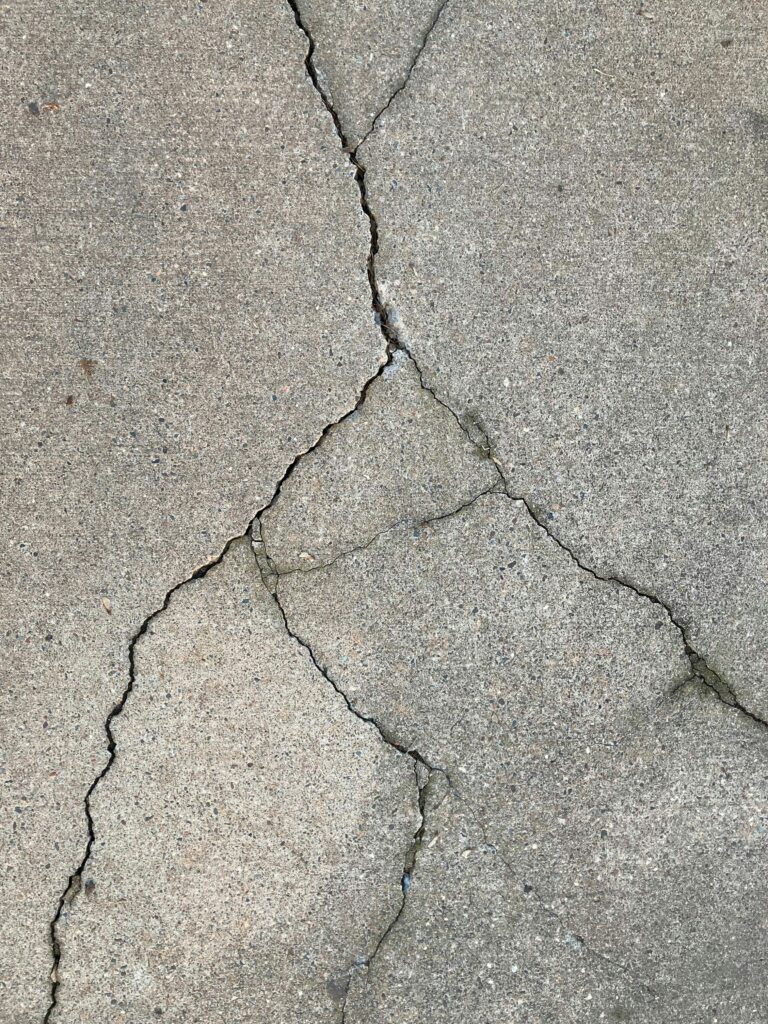
Knowing the type of damage tells you which fix fits.
Quick homeowner checks: Does any panel rock or sound hollow when tapped? Does water sit in the same place after rain? Is the flaking shallow and surface-level, or are chunks missing? Those answers matter more than the size of the damaged area. Front steps show damage early. If yours are crumbling at the nosing, see concrete stairs & steps repair.
On sound concrete, a penetrating sealer (silane/siloxane-type) reduces how much water the surface absorbs while still letting the slab breathe. For most outdoor flatwork here, that is the usual starting point. Film-forming acrylics can look great on decorative work, but they can get slick in the rain and may peel when moisture is trapped underneath. The penetrating vs acrylic guide covers that choice.
What sealer cannot do: reattach flaking paste, fill spalls, fix ponding, or steady a rocking panel. Sealing over active scaling mostly preserves a damaged surface. Drainage still comes first. See fix drainage before resurfacing.
The decision depends on two things: how deep the damage goes, and whether the slab underneath is still sound.
Whichever path fits, the water problem that fed the damage has to be solved too. Otherwise the next few winters repeat the story on the new surface. Olsen does not publish $/sq ft prices, freeze-cycle counts, or lifespan promises online. Scope is confirmed on the free on-site assessment.
A complimentary phone and photo review is the fastest way to start. Send:
Call (425) 215-2560 or start from olsenconcrete.com. Next step: photos → phone review → free on-site assessment. Olsen is based in Lake Stevens and serves Snohomish and King County. Hours Mon–Sat 7:00 AM–6:00 PM. More answers: concrete repair FAQ.
More repair answers live on our concrete repair FAQ.
Yes. Seattle’s freezes are usually short, but concrete here stays wet for much of the fall, winter, and spring. Damage comes from water freezing inside saturated concrete, so a few freezing nights on a soaked slab can cause scaling. Shaded, ponding, and ice-melt areas are hit hardest. Call (425) 215-2560 for a complimentary photo review.
Sealing sound concrete with a penetrating sealer reduces how much water the surface absorbs, which lowers freeze-thaw stress. It does not repair concrete that is already flaking or spalling, and it does not fix ponding. Keep water moving off the slab and reseal when water stops beading.
Often, yes, if the slab underneath is sound and panels do not rock or sound hollow. Loose material is removed, the surface is mechanically prepared, and a bonded overlay becomes the new wearing surface. Deep damage, rocking panels, or a failed base usually point to section replacement instead. Olsen confirms candidacy on a free on-site assessment.
Scaling is thin flaking of the surface paste that exposes sand and small stone. Spalling is deeper, with chips or chunks breaking out, often at edges and joints. Scattered cone-shaped craters are popouts. Each points to a different repair, so photos of the damage help.
Ice melt does not cause freezing, but aggressive deicers add stress and can speed up scaling on concrete that is already wet. Shovel or broom early, use sand or grit for traction, and use melt products sparingly. Olsen’s ice melt and winter care page covers deicer habits in more detail.
Seal during a dry stretch when the concrete is clean, dry, and within the temperature range on the product label. In Western Washington, the late-summer and early-fall dry weather before the rains return is a common window. Remove moss and dirt first.
Olsen Concrete is based in Lake Stevens and serves Snohomish and King County. Start with a complimentary phone/photo review; if a visit makes sense, the on-site assessment is free. Hours Mon–Sat 7:00 AM–6:00 PM. Call (425) 215-2560.
Send photos of flaking, pitting, or ponding for a complimentary phone review. If a visit makes sense, the next step is a free on-site assessment. There is no assessment fee. Hours: Mon–Sat 7:00 AM–6:00 PM. Call (425) 215-2560.
Or call (425) 215-2560. Licensed · Bonded · Insured · Lake Stevens, WA · Serving Snohomish and King County · Mon–Sat 7:00 AM–6:00 PM · olsenconcrete.com.